



Systems Chemistry Laboratory
The Systems Chemistry Laboratory develops molecular systems that exhibit life-like behavior by combining principles from chemistry, physics, engineering, and materials science. Our research seeks to understand how complex functions emerge from networks of interacting molecules and to harness these principles to create adaptive materials, autonomous chemical systems, and next-generation medical and chemical technologies.
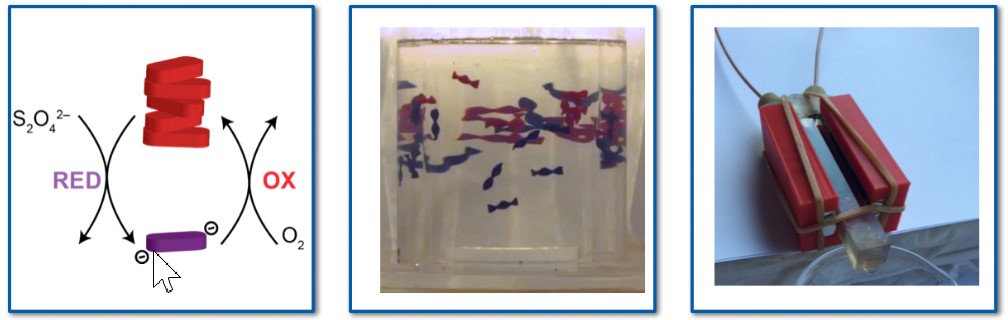
A central theme of our work is out-of-equilibrium systems chemistry, where chemical reaction networks continuously drive supramolecular self-assembly. We design chemically fueled molecular systems that can grow, reorganize, communicate, and respond to their environment, with the long-term goal of creating micrometer-scale supramolecular robots capable of autonomous behavior. In parallel, we investigate how molecular interactions give rise to collective phenomena such as chirality amplification, self-organization, dynamic materials, and emergent functions that cannot be predicted from the individual building blocks alone.
A second research direction focuses on wall-less microfluidics, in which liquids are manipulated without solid boundaries using magnetic confinement. By replacing conventional solid channels with liquid interfaces, we develop fundamentally new approaches to flow chemistry, transport, mixing, and reaction engineering. These concepts have led to applications ranging from more efficient continuous-flow reactors to novel biomedical devices. Our current efforts include the development of liquid-based extracorporeal membrane oxygenation (ECMO) systems designed to reduce blood damage by eliminating many of the solid surfaces responsible for clotting and hemolysis in existing technologies.
In all of our projects, we combine molecular design, advanced microscopy, microfluidics, spectroscopy, computational modeling, and engineering to bridge fundamental discovery with technological innovation. By integrating systems chemistry with soft matter, fluid dynamics, and biomedical engineering, we aim to uncover the physical principles underlying complex chemical systems while translating these insights into practical solutions for healthcare and advanced materials.