




Researchers tune quantum entanglement and coherence using attosecond laser pulses
01.04.2026
 |
|
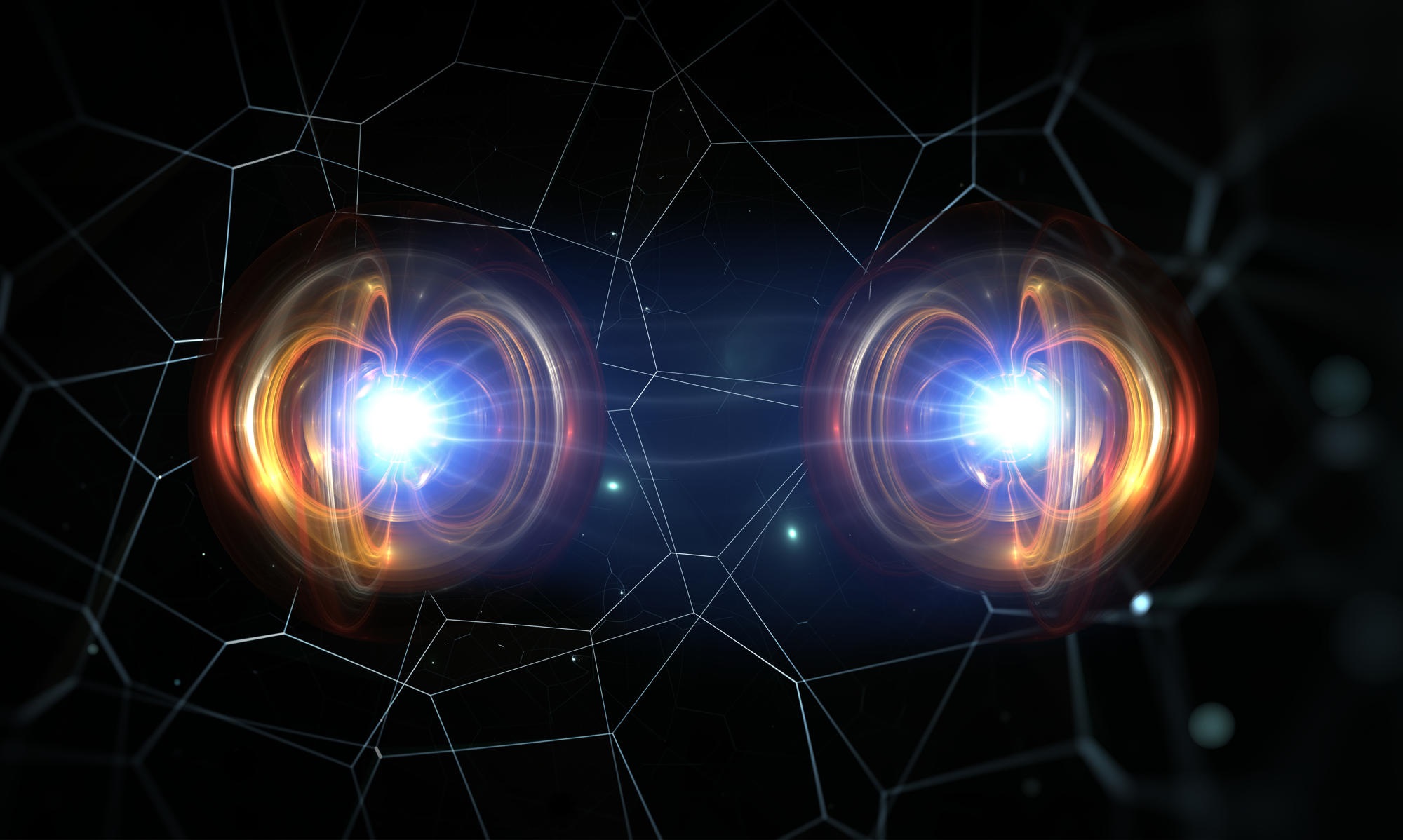
Credit: Jurik Peter/Shutterstock. |
- Researchers at IMDEA Nanociencia, UAM and Max Born Institute prove that the degree of quantum entanglement between a hydrogen molecular ion and a photoelectron can be controlled by an external stimulus.
- Entanglement and coherence are complementary: the delay between a pair of attosecond pulses modifies the degree of entanglement at the cost of quantum coherence.
- The work opens the way to manipulating coherences and entanglement in other more complex systems.
| Tweet |  |
Press release download |
Madrid, 1st April, 2026. Researchers are pushing the limits of how we understand and control matter at its most fundamental level. At the heart of this effort lies quantum mechanics—a theory that describes a world where particles exist in multiple states at once and remain connected through quantum entanglement. These effects are notoriously difficult to observe and control, because they are fragile and lost in the interaction with the environment. Researchers have now succeeded in controlling the quantum entanglement between electrons and molecular ions at the natural timescale of electron motion: the attosecond.
In a new study, researchers at Autonomous University of Madrid, Max Born Institute and IMDEA Nanociencia Institute have demonstrated a way to control the quantum entanglement at the attosecond time scale. By using a precisely timed sequence of two attosecond laser pulses combined with a slightly longer infrared pulse, they ionized hydrogen molecules and monitored the dynamics of the resulting system: a molecular ion and a freed electron. By carefully adjusting the delay between the pulses, the team was able to tune the degree of quantum entanglement between these two systems.
Coherence describes how well systems exhibit wave-like interference, while entanglement links pair of systems so that measuring one immediately reveals information about the other. Prof. Fernando Martín, principal author of the study explains: “We found that coherence and entanglement properties are complementary: increasing entanglement tends to reduce coherence, and vice versa”. Entanglement compromises the ability to explore coherent ultrafast electron dynamics within ions or of their accompanying photoelectrons Prof. Marc Vrakking says: “We can move from one regime to the other simply by changing the timing between laser pulses”. This work demonstrates the importance of a proper consideration of entanglement for the optimal observation of electronic coherences in attosecond experiments.
This work uncovers a fundamental aspect of quantum behavior. Beyond its intrinsic scientific significance, it may also have important implications for emerging technologies. The findings suggest new ways to enhance or, if desired, suppress quantum entanglement in molecular systems, a capability that could provide additional support to the continued development of quantum information technologies. Quantum computing, for example, depends on entangled states (qubits) that are highly fragile and easily disrupted by environmental noise. Current strategies typically focus on correcting errors after they occur. By contrast, this research could point to a new approach: actively controlling quantum states to preserve or even restore entanglement in real time. While still a very distant application, the ability to manipulate coherence and entanglement on ultrafast timescales could open new pathways for stabilizing quantum systems.
Attosecond pulses, consisting of extreme-ultraviolet radiation with photon energies exceeding the binding energies of any conceivable compound (atom, molecule, liquid or solid), lead to photoionization and the formation of a bi-partite system: an ion and a photoelectron. Photoionization often creates entangled ions and photoelectrons, implying that the wave function cannot be written as a single product of ionic and photoelectron wave functions. The goal of this work was the observation of the ultrafast motion of the hole left behind in the hydrogen molecule after the departure of the electron. The observation of such dynamics requires the existence of electronic coherences in the residual molecular ion, meaning that the remaining electron in the ion cannot be assigned to a specific quantum state. The experiment and the calculations determined on which side of the molecule this hole remained at the end of the experiment, when the H2+ ion dissociated in a neutral H-atom (containing the single remaining bound electron) and an H+ ion (containing the hole left behind by the photoelectron). They also showed that the ability to observe the hole dynamics or, equivalently, the coherent electron dynamics in the H2+ ion depends on the delay between the pair of attosecond pulses that ionize the neutral H2 molecule, which in turn modifies the degree of entanglement between the H2+ ion and the photoelectron. By varying the delay between the pair of attosecond pulses and the infrared pulse, an oscillation in the position where the hole was preferentially located at the end of the experiment was observed. The amplitude of this oscillation, that is to say, the degree of coherence, depends on the delay between the two attosecond pulses. The easiness to see hole localization is inversely proportional to the degree of entanglement and viceversa. The entanglement in the pair ion + photoelectron system is almost always at the spent of electronic coherences in the remaining molecular ion, thus allowing one to control them by just varying the delay between the pulses.
Interestingly, the study bridges two areas of physics that recently earned Nobel Prizes but are rarely connected. In 2022, Alain Aspect, John F. Clauser and Anton Zeilinger received the Nobel Prize "for experiments with entangled photons, establishing the violation of Bell inequalities and pioneering quantum information science". Subsequently, in 2023, Pierre Agostini, Anne L’Huillier and Ferenc Krausz received the Nobel Prize "for experimental methods that generate attosecond pulses of light for the study of electron dynamics in matter". At first sight these two Nobel Prizes have little in common: one recognized pioneering work on quantum entanglement, while the other honored the development of attosecond laser pulses to observe electron dynamics. By combining these fields, this research highlights how attosecond science can be used not just to observe, but also to control entangled quantum systems.
The study has been published in Nature and is the result of a collaboration between researchers at IMDEA Nanociencia, Universidad Autónoma de Madrid, and the Max Born Institute in Berlin. This work has been cofunded by the Spanish Ministry of Science, Innovation and Universities through grants PID2022-138288NB-C31 and CEX2020-001039-S (Severo Ochoa Excellence award to IMDEA Nanociencia).
Glossary:
- Quantum entanglement: a phenomenon wherein two particles that have at some point interacted in the past retain a memory of its interaction to such an extent that acting on one of the two particles has a measurable influence on the properties of the other, even if the two have stopped interacting and are separated so far away that communication between them is no longer possible. Entanglement is highly fragile and is lost through interaction with the environment. The use of quantum entanglement in communication and computation is an active area of research and development.
- Quantum coherence: the ability of quantum particles to exist simultaneously in multiple states (superposition) while maintaining a fixed phase relationship, allowing them to exhibit wave-like interference. As for entanglement, coherence is highly fragile and and is lost through interaction with the environment.
- Attosecond: unit of time equal to 10-18 seconds, a billionth of a billionth of a second. To put it into perspective, an electron “moving” around a hydrogen atom takes around 100 attoseconds to complete a lap around the nucleus.
Reference
Lisa-M. Koll, Adrián J. Suñer-Rubio, Tobias Witting, Roger Y. Bello, Alicia Palacios, Fernando Martín, and Marc J. J. Vrakking. "Control of quantum entanglement and electronic coherence in attosecond molecular photoionization". Nature (2026). DOI: 10.1038/s41586-026-10230-2
 Link to IMDEA Nanociencia Repository: https://hdl.handle.net/20.500.12614/4249
Dataset: https://zenodo.org/records/18472517
Contact:
Fernando Martín
This email address is being protected from spambots. You need JavaScript enabled to view it.Modelling Physical Properties of Nanostructures Group
https://nanociencia.imdea.org/fernando-martin-s-group/group-home
IMDEA Nanociencia Dissemination and Communication Office
divulgacion.nanociencia [at]imdea.org


Source: IMDEA Nanociencia.
IMDEA Nanociencia Institute is a young interdisciplinary research Centre in Madrid (Spain) dedicated to the exploration of nanoscience and the development of applications of nanotechnology in connection with innovative industries.